
Authenticate
Establish identity and authenticator assurance using phishing-resistant or deployment-approved methods.
Atlas brings identity, authentication, policy, devices, federation, and evidence into one clear control plane for enterprise, cloud, and edge.
Built for connected, federated, and disconnected operations.
The operating model
Atlas keeps the evidence used for a decision bound to the subject, session, resource, action, and policy. The result can be explained, reviewed, and reproduced while resource policy retains decision authority.
Establish identity and authenticator assurance using phishing-resistant or deployment-approved methods.
Assemble current identity, device, relationship, threat, mission, and session evidence.
Apply resource-specific policy, obligations, step-up, and explicit deny conditions at the point of access.
Bind the outcome to policy and evidence digests for operations, investigation, and governance.
A coherent ICAM platform
Directory, assurance, policy, lifecycle, and evidence are connected by explicit contracts. Teams can modernize an application at a time while preserving the incumbent route and an observable rollback path.
Normalize people, groups, roles, devices, applications, entitlements, and source relationships while preserving provenance.
Directory architecture →Compose passwordless, WebAuthn/FIDO2, TOTP, certificate, smart-card, and step-up journeys under explicit assurance policy.
Assurance controls →Operate OIDC/OAuth, SAML, SCIM, LDAP, and bounded legacy federation profiles through managed trust and key lifecycles.
Protocol matrix →Express resource, subject, assurance, context, relationship, and trust requirements as reviewable decision logic.
Policy model →Project evidence quality and adverse signals into a purpose-bound score, while keeping authorization with policy.
How projection works →Carry decision receipts, approvals, source lineage, session state, and operational proof into one review path.
Evidence model →Controlled migration
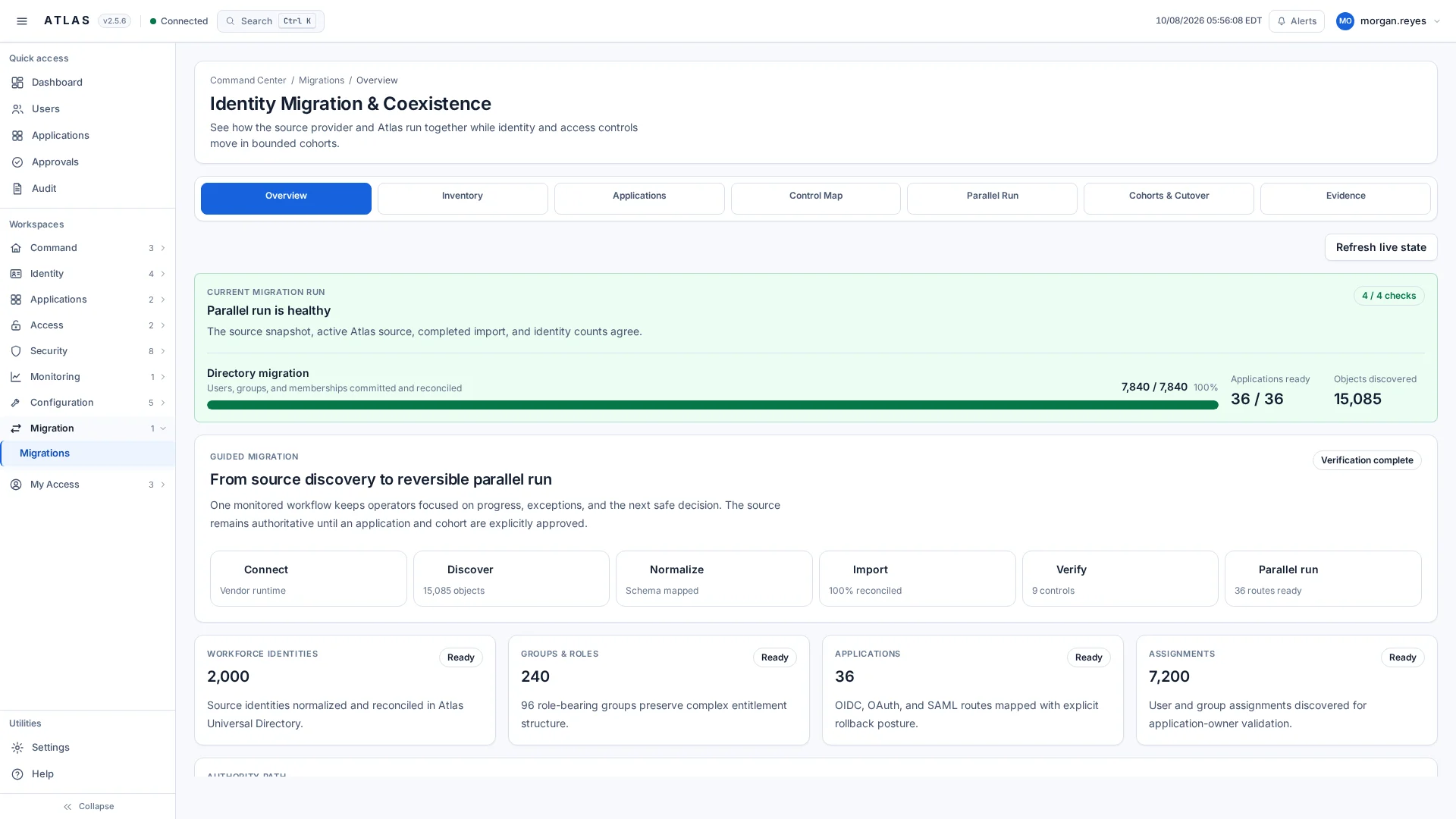
The migration workspace turns a large identity estate into a staged program. Atlas imports attributed evidence, compares control behavior, and keeps the source platform as an explicit route until each application and cohort is approved.
Federation with boundaries intact
Atlas can exchange signed, audience-bound trust assertions and restriction signals across organizations. The receiving organization validates the issuer, freshness, purpose, and scope, then applies its own policy. The receiving organization retains local authorization authority.
See the mission-partner pattern →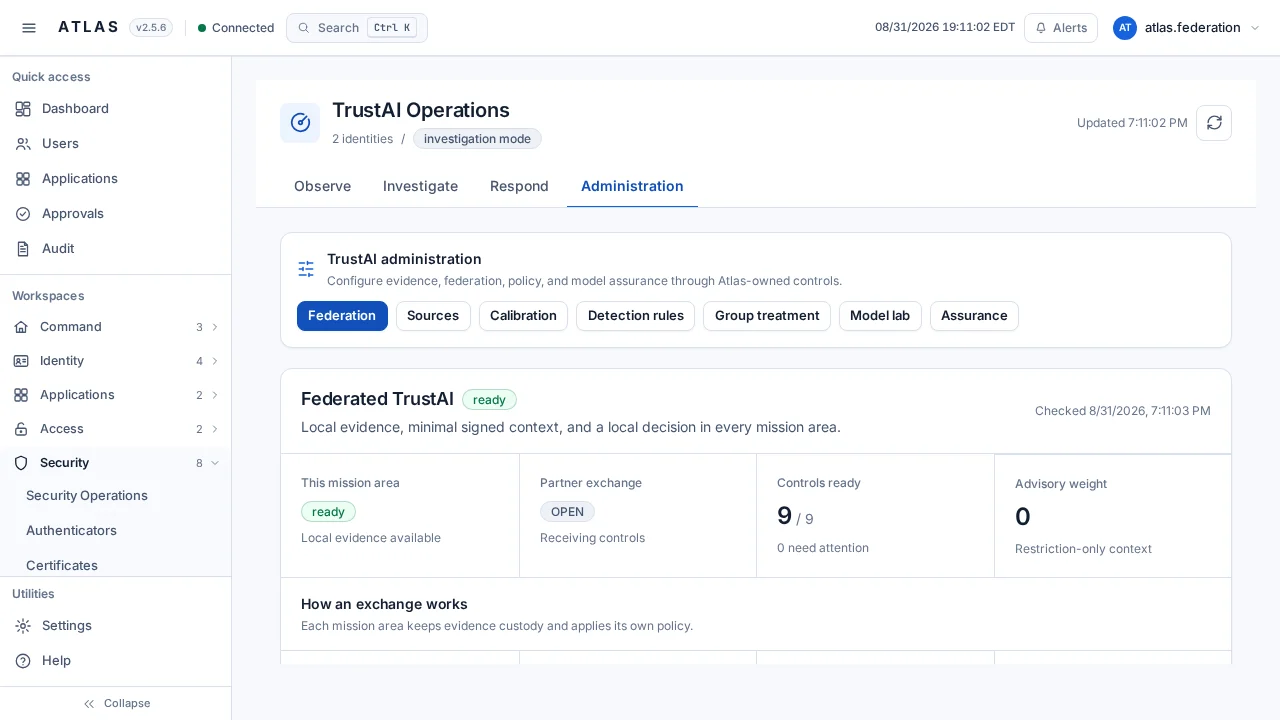
One model, several operational shapes
A single-container AIO supports labs and constrained edge demonstrations. Production-shaped deployments externalize durable state, keys, time, observability, and recovery across Kubernetes or managed AWS services.
Highly available control-plane services, external custody, managed databases, load balancing, and region-aware session posture.
Local evaluation against signed policy and bounded evidence, with queued synchronization and conflict handling after reconnect.
Independent authorities exchange explicitly scoped assertions while retaining local policy, audit, and revocation control.