
Before separation
Distribute signed policy, issuer trust, key material, revocation posture, subject scope, and time constraints.
Logical architecture
Atlas separates evidence collection, identity authority, policy evaluation, enforcement, and audit so each signal, assertion, and model result retains its defined authority in the access path.
System layers
The browser and API surface present one operational experience. Underneath, services maintain narrow responsibilities and communicate through authenticated interfaces, durable event paths, and policy-bound records.
Runtime path
Authentication establishes control of an authenticator at a stated assurance. Resource policy evaluates the requested action against current evidence and returns an outcome and obligations to the enforcement point.
Bind subject, client, session, requested resource, action, and authenticators.
Resolve authoritative identity, entitlement, device, threat, relationship, and trust evidence under a named policy version.
Allow, step up, deny, or return indeterminate; enforce obligations and emit a digest-bound receipt.
Data and authority
Atlas records which source asserted a fact, when it was observed, how long it is valid, and which transformation produced the normalized value.
A fast answer is useful. An answer that can be traced to the right authority, policy, and point in time is operationally defensible.
Identity authority owns the canonical subject and lifecycle state.
Policy authority owns approved decision logic and activation.
Evidence authorities attest observations within defined scope.
Enforcement points apply the returned result to a named resource and action.
Federated operation
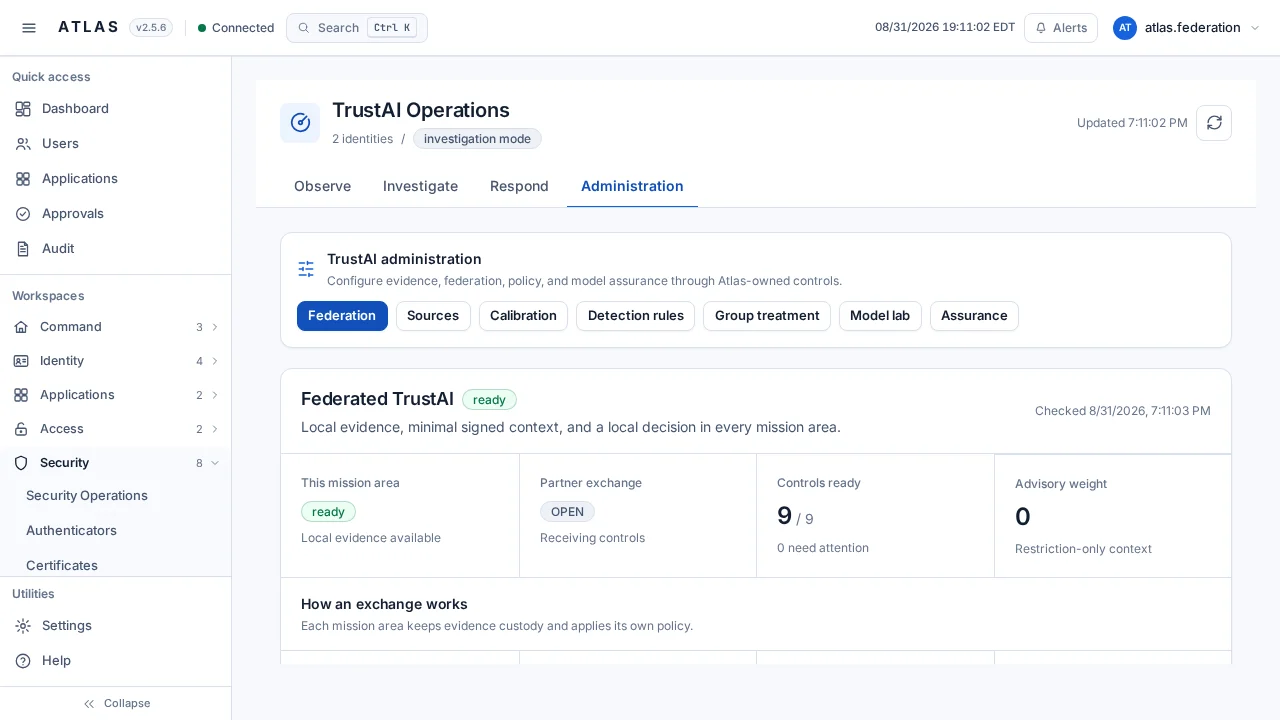
Cross-boundary messages are signed, issuer-bound, audience-bound, purpose-limited, time-bounded, and replay-controlled. A receiving authority checks applicability before mapping claims or adverse signals into its own policy namespace.
Edge and DDIL
At the edge, Atlas evaluates signed policy and locally available evidence inside an explicit freshness window. It queues attributable changes for reconciliation and surfaces missing central confirmation and applies the defined resource policy.
Distribute signed policy, issuer trust, key material, revocation posture, subject scope, and time constraints.
Use local authority for bounded decisions; surface stale evidence and unavailable dependencies in the result.
Verify origin and ordering, replay queued evidence, resolve conflicts, and record reconciliation outcomes.
Failure behavior
Each dependency is classified by authority and criticality. Atlas can deny, request step-up, return indeterminate, or operate within a bounded cached window. Administrative surfaces show which dependency changed the posture.
Required evidence is fresh and all policy conditions pass.
Additional assurance can satisfy the current policy floor.
A hard gate, veto, or explicit policy condition rejects access.
A required authority or dimension cannot support a valid decision.